Critical text
Drafted by the archive with the help of AI, not written by the artist.
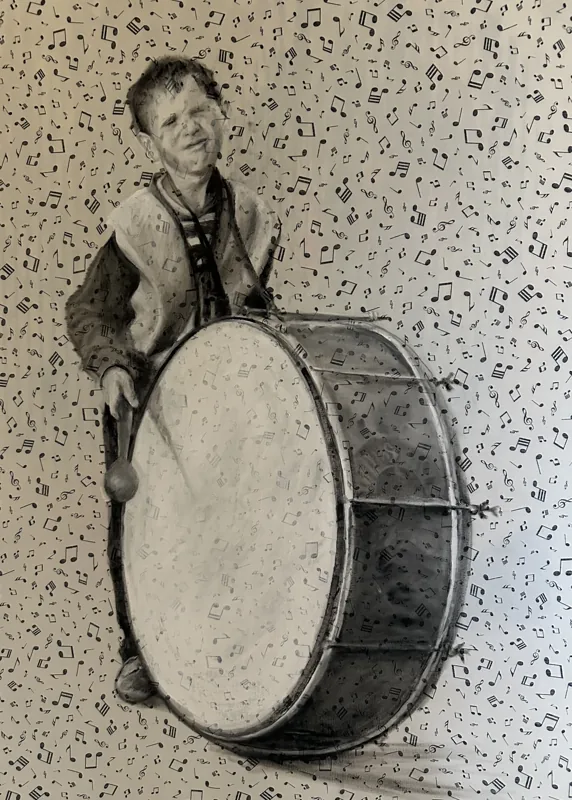
In the Contemporary Interferences series, the musical gesture finds no explanatory order in notation: the signs surrounding it instead expose it to visual repetition. Zampogna treats the cellist as a figure engaged in an activity that calls for time, listening and succession, then places him in a field where musical signs recur without forming an audible phrase. In earlier phases the artist brought together images from different sources; here the interference does not arrive from outside the subject. It arises between the gesture and the surface that claims to make it visible but cannot convey music's duration.
Scattered notes on the fabric cross the boundaries between setting, body and cello: what might suggest a language shared by player and instrument also appears as an ornamental pattern, indifferent to their movement. Repetition does not accompany the sound; it fills the space in which sound might be imagined. The music stand raises the expectation of a score, yet its dark, perforated surface offers no legible sequence. A gap thus opens between the place assigned to reading and the signs dispersed across the fabric: notation seems to be everywhere except where it might guide the performance. The textile support sustains this gap, since its pattern continues through the painted forms rather than stopping at the figure.
The work moves Zampogna's familiar contamination of lived reality and coded image into an experience that sight cannot verify. The musician remains recognizable through his gesture, but this proliferation of graphic signs tells us neither what he plays nor whether the signs have any precise musical function. What matters is not the depiction of a particular piece: it is the difference between an activity unfolding in time and its reduction to a surface. Zampogna lets these conditions coexist without reconciling them, making music a particular instance of his inquiry into what an image brings into presence and what it keeps beyond the frame.
Related

Dialogo
same series
2026

Il danzatore
same series
2026

La banana di Cattelan
same series
2025

Performance 1, 2024
same series
2024

Performance 1, 2025
same series
2025

Senza titolo 11
same series
2026

Senza titolo, n. 4
same series
2026

Senza titolo, 2026
same series
2026

Senza titolo, n. 10
same series
2025
Senza titolo, n. 12
same series
2026

Tre ragazze a Roma
same series
2026

Turisti a Roma
same series
2026